
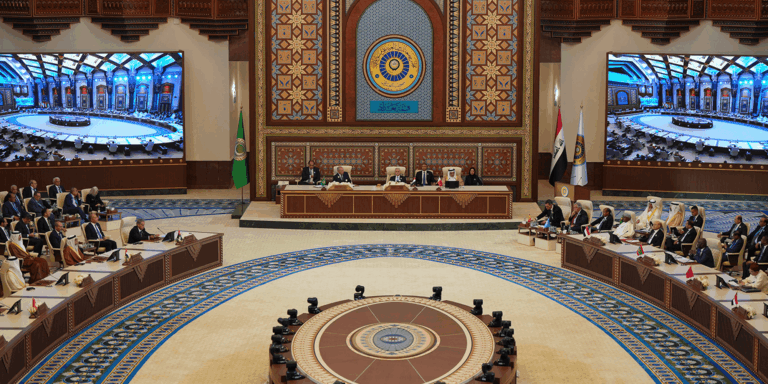
On May 17, 2025, the 34th Arab League Summit, alongside the 5th Arab Economic and Social Development Summit, concluded in Baghdad. Hosted by Iraqi President Abdul Latif Rashid and Prime Minister Mohammed Shia Al Sudani, the gathering brought together Arab leaders to address key regional and international issues. The final outcome was the Baghdad Declaration — a broad appeal for peace, stability, and unified action across the Arab world.
Gaza and the Palestinian Cause Take Center Stage
One of the summit’s central topics was the situation in Gaza. Leaders called for an immediate ceasefire and proposed the deployment of UN peacekeeping forces in the Palestinian territories. The declaration reaffirmed the Arab world’s support for a two-state solution based on the 1967 borders, with East Jerusalem as the capital of a future Palestinian state. It also strongly opposed any forced displacement of Palestinians and emphasized the importance of continuing humanitarian assistance, including full backing for UNRWA.
Recent moves by several European countries recognizing the State of Palestine were welcomed. The summit also supported South Africa’s case at the International Court of Justice accusing Israel of genocide, and urged Palestinian factions to pursue unity. Leaders reiterated their call for an international peace conference to help advance these goals.
Renewed Engagement on Syria
The summit voiced full support for Syria’s sovereignty and condemned ongoing Israeli strikes on Syrian territory. Notably, it welcomed the recent announcement by U.S. President Donald Trump to lift sanctions on Syria, as well as signs of easing restrictions from Europe. These developments were seen as vital steps toward Syria’s recovery and the voluntary, safe return of displaced people. Iraq offered to host a national Syrian dialogue in cooperation with the Arab League.
Broader Regional Concerns
The declaration also touched on conflicts in Libya, Yemen, Sudan, and Lebanon, urging political solutions through dialogue, national reconciliation, and the withdrawal of foreign forces where applicable. Leaders reaffirmed the United Arab Emirates’ sovereignty over the islands of Abu Musa, Greater Tunb, and Lesser Tunb, encouraging peaceful negotiations with Iran or recourse to the International Court of Justice.
Arab water security was highlighted as a national priority, with explicit support for Iraq, Egypt, Sudan, and Syria in defending their rights to transboundary water sources.
Economic Cooperation and Security Initiatives
Leaders pledged to deepen collaboration on food, health, and energy security, and to intensify efforts to address climate change. The summit condemned terrorism in all its forms, reaffirmed support for Iraq’s counter-terrorism initiatives — including its new National Center for Countering Terrorism — and endorsed Baghdad’s plan to host an international conference for victims of terrorism in 2026.
The statement also backed the creation of a weapons-of-mass-destruction-free zone in the Middle East and emphasized the need for stronger cybersecurity cooperation. Saudi Arabia’s initiative to establish an Arab Cybersecurity Council was acknowledged as a key step forward.
Finally, the declaration welcomed ongoing U.S.-Iran talks on the peaceful use of nuclear energy, praising Oman’s mediating role, and expressed condolences on the passing of Pope Francis.
Source: Based on reporting from IraqiNews.com (May 2025)